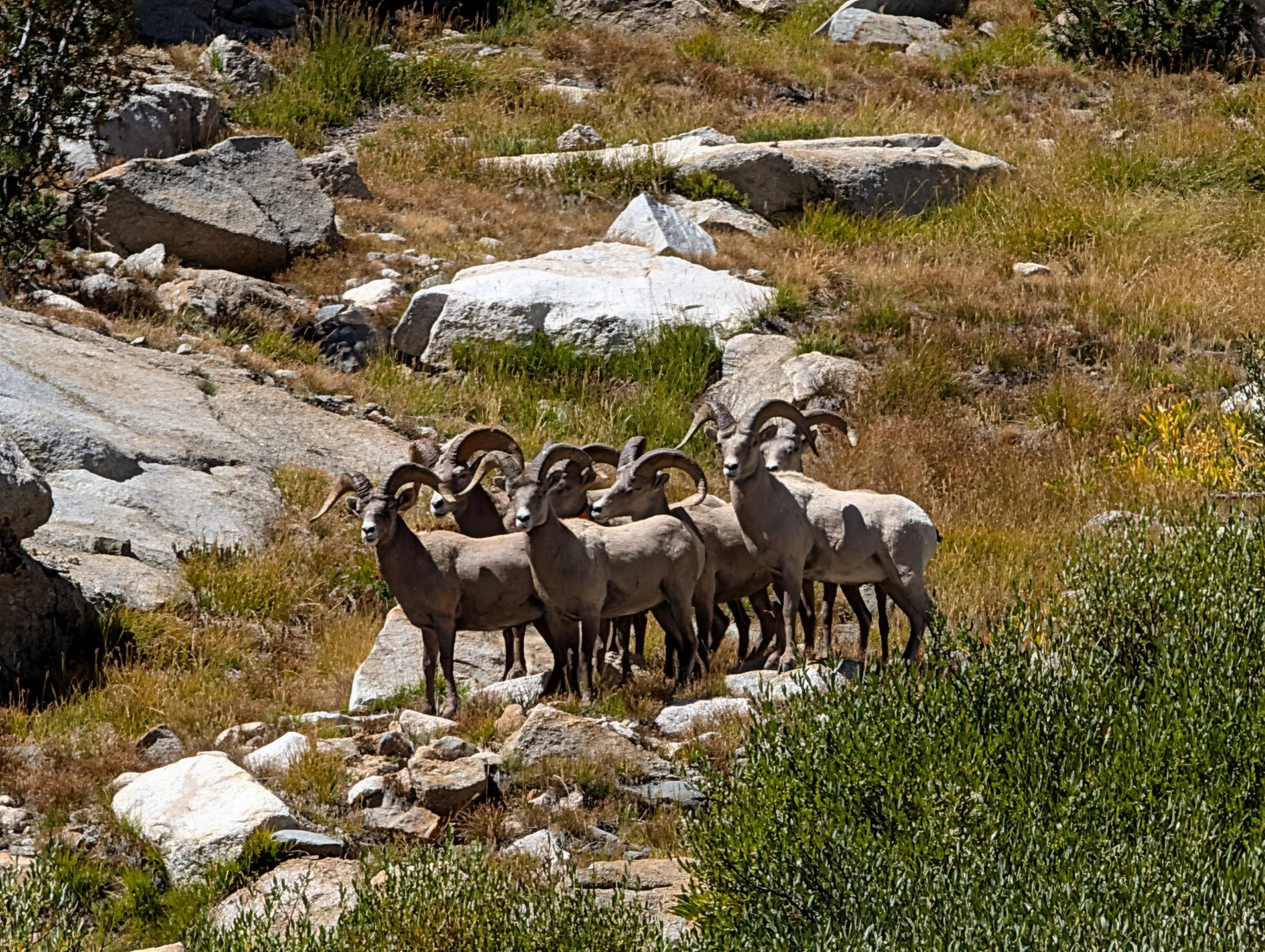
While hiking through the rugged alpine terrain of Rae Lakes in Sequoia and Kings Canyon National Parks, our group had a rare and magical encounter with a band of endangered Sierra Nevada bighorn sheep (Ovis canadensis sierrae).
As we approached a granite ridge, a group of approximately 8–10 rams appeared over the crest, descending the granite terraces toward us. We were mesmerized. It was a healthy-looking group of varying ages. Outside the breeding season, male bighorn sheep often travel together in bachelor groups, while females and their young generally form separate herds. Watching these magnificent animals move gracefully through their mountain habitat was extraordinary. They are majestic creatures and it felt like being in the presence of royalty.
There's something special about encountering these animals in their natural habitat, deep in the High Sierra, among the lofty peaks and rocky alpine slopes, often above 10,000 feet. The experience is more meaningful when you understand how close they came to disappearing from these mountains.
The Sierra Nevada bighorn sheep is one of North America's rarest large mammals, a genetically distinct subspecies that has inhabited these mountains for thousands of years. Historical estimates suggest that more than 1,000 sheep once roamed the Sierra Nevada.
During John Muir’s explorations of the Sierra Nevada in the 1870s, he frequently encountered bighorn sheep. He admired their incredible agility, strength, and ability to thrive in some of the mountains harshest terrain. In his 1894 book, The Mountains of California, Muir devoted a chapter to these magnificent animals, titled "The Wild Sheep," describing them as "the bravest of all the Sierra mountaineers." Muir believed their remote mountain habitats would protect them from the threats that were decimating other North American wildlife, including elk, moose, and buffalo.
Muir wrote, “Man is the most dangerous enemy of all, but even from him our brave mountain-dweller has little to fear in the remote solitudes of the High Sierra."
He was confident that they would stay safe, high in the inaccessible peaks, far from human encroachment. Little did he know that within the next century, these admired animals would be pushed to the brink of extinction.
During the 19th century, as settlers brought domestic livestock into the Sierra Nevada, bighorn populations began to decline dramatically. Disease transmitted by domestic sheep, competition for grazing resources, and unregulated hunting contributed to their disappearance across much of their historical range.
By the early 1900s, bighorn sheep had vanished from many of their ancestral habitats, including Yosemite National Park. By the 1970s, only a few isolated populations remained. In 1986, biologists relocated 27 bighorn sheep to the alpine crest near the Yosemite-Inyo National Forest boundary, marking an important step toward restoring the species to its historical range.
Despite these early conservation efforts, populations continued to struggle. By 1995, approximately 100 individuals remained throughout the Sierra Nevada, bringing this majestic mountain species dangerously close to extinction.
In 1999, the Sierra Nevada bighorn sheep received emergency protection under the federal Endangered Species Act, launching a more intensive recovery effort. Through decades of dedicated conservation work, including carefully managed reintroductions, habitat protection, and population monitoring, bighorn sheep began returning to portions of their historical range. By 2015, their population had rebounded to more than 600 individuals. While that was a move in the right direction, their recovery remains fragile.
The extreme winter of 2022 - 2023 brought devastating losses, with an estimated 55% mortality rate. Avalanches, deep snow, starvation, and increased vulnerability to mountain lion predation contributed to the decline. Disease transmission from domestic sheep still remains a serious threat. By 2025, the population was estimated at approximately 400 individuals.
Today, Sierra Nevada bighorn sheep remain federally and state endangered, and their recovery continues to be an important conservation priority.
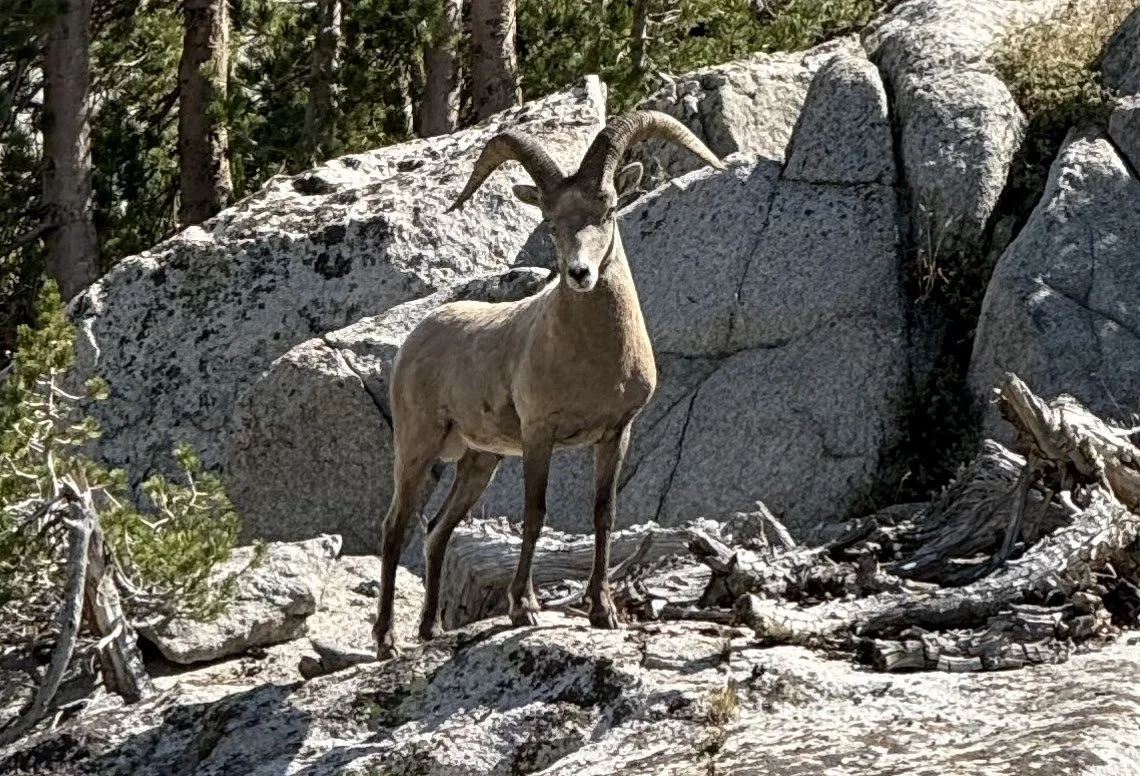
A Wild Presence Worth Protecting
The story of the Sierra Nevada bighorn sheep is one of resilience and survival. Their continued presence in these mountains is a testament to decades of dedicated conservation work and a reminder of how important it is to protect and restore the wild places and species that inhabit them.
Standing on that granite ridge in the High Sierra, watching those magnificent rams move through a landscape their ancestors have inhabited for thousands of years, was a moment of pure awe. Knowing how close we came to losing these animals made the encounter that much more meaningful. What an honor to share that moment in the wild.