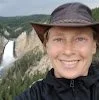
A few days ago, I was out in Hetch Hetchy scouting our Hidden Waters route. Being out there alone, with the waterfalls running high and everything feeling very alive, I found myself thinking about John Muir.
Muir loved this place deeply- Hetch Hetchy valley was one of his most cherished landscapes. He fought tirelessly to protect it from being dammed, and when it was ultimately lost, it broke his heart. Not long after, he passed away. We hear a lot about Muir and of his love and advocacy for Yosemite and wild places. What also is notable was his evolution as a human being.
Muir’s early life had its challenges, an overbearing upbringing in Scotland, and a near-fatal accident that temporarily took his sight-experiences which ultimately led him to Yosemite in 1869. Like many people of his time, some of his early writings and views were limited and harmful regarding Native people. Later in life, after spending time with Natives in Alaska, his words reflected a broader respect and admiration. Muir’s life reminds me that compassion is not always something we arrive at fully formed. It can widen over time, through experience, humility, and relationship. Did he expand his circle? In some ways, yes. And maybe that is the lesson of Muir: our work is not only to love the land more deeply, but to keep expanding who and what we include in that love.
It reminded me of Aldo Leopold, who went through his own widening of perspective.
Early in his career, Leopold participated in predator eradication efforts, a common practice at the time. But in A Sand County Almanac, he writes about a moment that stayed with him for the rest of his life: watching the “fierce green fire” fade from the eyes of a wolf he had shot. In that moment, something in his understanding changed. He began to see that the wolf was not separate from the mountain, the deer, the forest, or the health of the land itself.
It brought me back to something John Muir once wrote:
“When we try to pick out anything by itself, we find it hitched to everything else in the Universe.”
And later, Leopold carried that truth forward in his own way:
“To keep every cog and wheel is the first precaution of intelligent tinkering.”
Different words, same truth: everything is connected, and how we treat one part affects the whole.
Leopold’s thinking eventually became what he called a land ethic that says ethics should enlarge/expand to include “soils, waters, plants, and animals,” or collectively, “the land.” It’s the idea that our responsibility does not stop with ourselves, or even with other people. It extends to soil, water, plants, animals, and the whole living community.
As he wrote:
“A thing is right when it tends to preserve the integrity, stability, and beauty of the biotic community. It is wrong when it tends otherwise.”
That, to me, is another kind of expanding circle. Not a perfect awakening. Not a clean or simple transformation. But a widening — from domination toward relationship, from usefulness toward reverence, from seeing land as something to manage to seeing land as a whole living system we belong to.
That is the work of a lifetime: to keep widening the circle of what we notice, what we value, and what we are willing to protect.
Being out there, it made me think about how this applies to all of us. We’re not fixed. We’re not stuck in one way of seeing the world. We’re always capable of learning, adjusting, and growing into a broader understanding- of people, of nature, and of our place within it. We are capable of evolving, of seeing more clearly, of becoming more compassionate than we were before. As Einstein put it, “widening our circle of compassion to embrace all living creatures and the whole of nature and its beauty.” That’s what spending time in nature does for us.
A recent research study that was just published by Dr. Paul Piff, a social psychologist from UC Irvine, on the effects of experiencing moments of awe- like the kind you experience standing beneath a waterfall or looking out across a vast landscape- can actually increase generosity and helpfulness. In one experiment, people who had just spent time in an awe-inspiring environment were more likely to stop and help a stranger who dropped a handful of pens. It’s a small example, but it points to something real.
Experiences in places like this, the Hetch Hetchy- or wherever you find yourself having a moment of awe in nature- don’t just feel good- they can shift how we show up in the world.
Out here, it feels obvious. When you slow down enough to take it all in, you start to remember- you’re part of something bigger. And that’s where it begins. Getting out and connecting with the natural world and allowing our circle to expand, one experience at a time.